Herbs are the kitchen's garden — small, fragrant and always within reach. This set of five crochet floor rug concepts translates five culinary herbs into rug geometry: basil as a capsule, rosemary as an oval, dill as a radial burst, lemon balm as an arch and thyme as a tiled panel. All images are AI-generated concept illustrations for inspiration, not photos of finished handmade pieces.
Botanical rugs succeed when the leaf's own structure suggests the rug's layout — vein becomes border, frond becomes radial, sprig becomes tile. When comparing the five, watch how each herb's growth habit becomes a different floor shape.
Basil capsule crochet rug
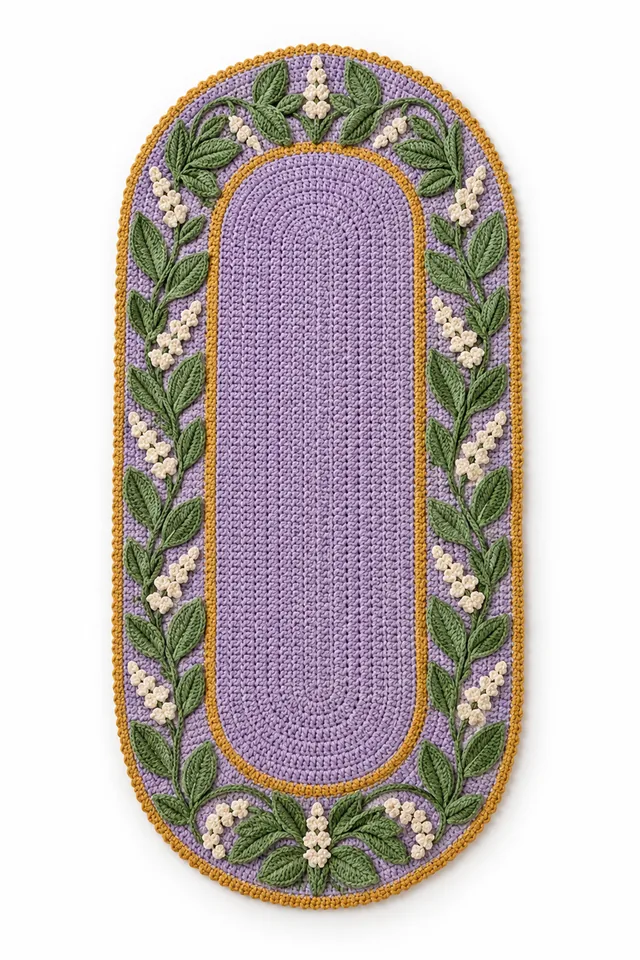
The basil capsule rug is the boldest leaf of the set — one broad, rounded blade in deep pesto green, with a lighter vein running down its length. Basil is the generosity herb, and the rug matches: big, soft and unapologetic.
A capsule shape — a rectangle with semicircle ends — is the friendliest rug geometry: no corners to curl, no direction to argue with. It suits galley kitchens and the floor in front of the sink.
For a mood board, this rug shows the vein as the design line. One strong central stripe organizes a solid field the way a stem organizes a leaf. When the motif is minimal, let one line carry it.
Compared with the thyme panel, basil is one leaf where thyme is many sprigs — the singular versus the colony. As with every image here, treat this as an AI-generated concept for inspiration, not as a pattern.
Blue rosemary oval crochet rug
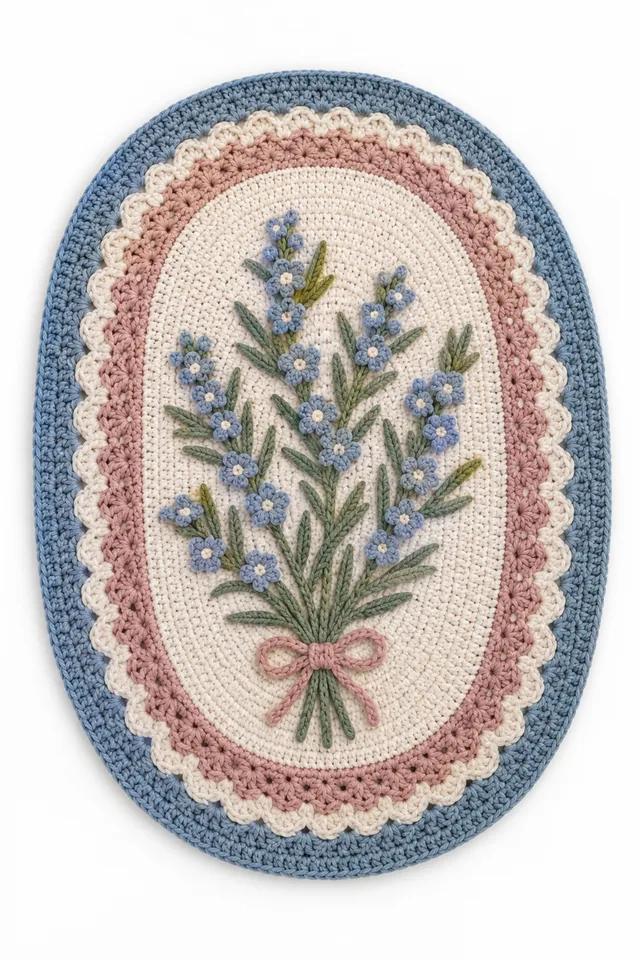
The rosemary oval rug is the most aromatic in spirit — needle-like sprigs worked in blue-green and silvery tones, radiating within a classic oval field. Rosemary is the memory herb, and its spiky texture gives the rug a fine, bristling energy.
Rosemary needles are linear texture: hundreds of short strokes in one direction. In a rug concept, that suggests dense looped or ridged stitching — a surface that would feel like a firm brush underfoot.
For a mood board, this oval demonstrates silhouette contrast: spiky motif inside a smooth outer edge. A calm border around busy content keeps a rug elegant instead of chaotic. Frame the wildness.
Set beside the dill radial, rosemary is disciplined spikes where dill is free explosion. The image remains an AI concept for character and palette inspiration only.
Dill radial crochet rug
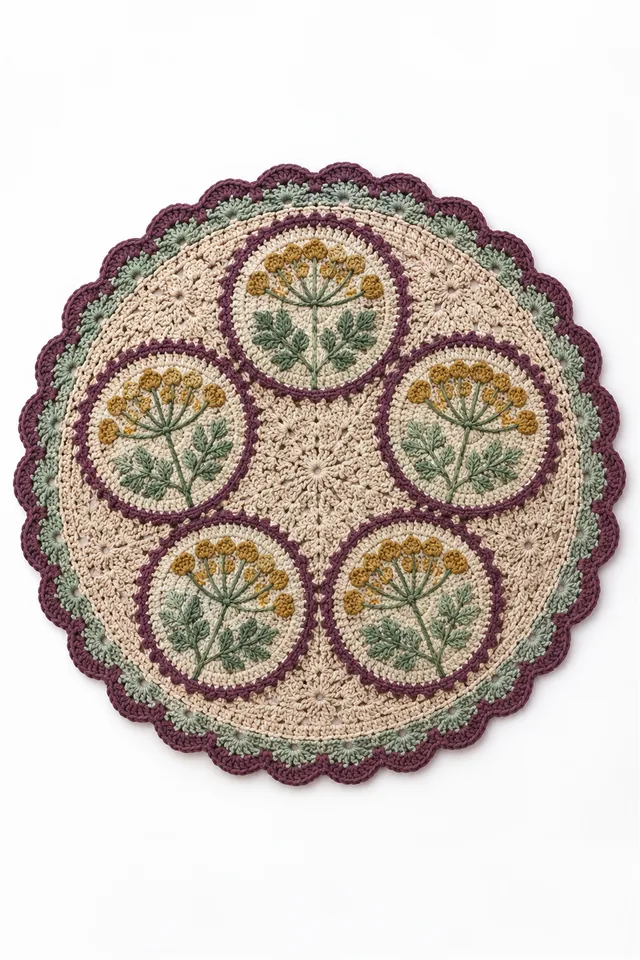
The dill radial rug is the firework of the set — feathery fronds bursting from a center point in pale green and gold, exactly as dill umbrellas burst in the garden. It is the lightest-looking of the five, all air and filament.
A radial layout is nature's own rug plan: everything flows from one center, so the eye always knows where home is. Radial rugs suit round tables and the center of a room, where their symmetry can breathe.
For a mood board, this rug shows graduation as movement: dense at the heart, sparse at the rim. Letting a design dissolve toward the edges makes a rug feel lighter than its actual weight. Fade out instead of cutting off.
Next to the lemon balm arch, dill is a full circle of energy where the arch is a single doorway. As always, this is an AI-generated concept image: borrow the burst, not the construction.
Lemon balm arch crochet rug
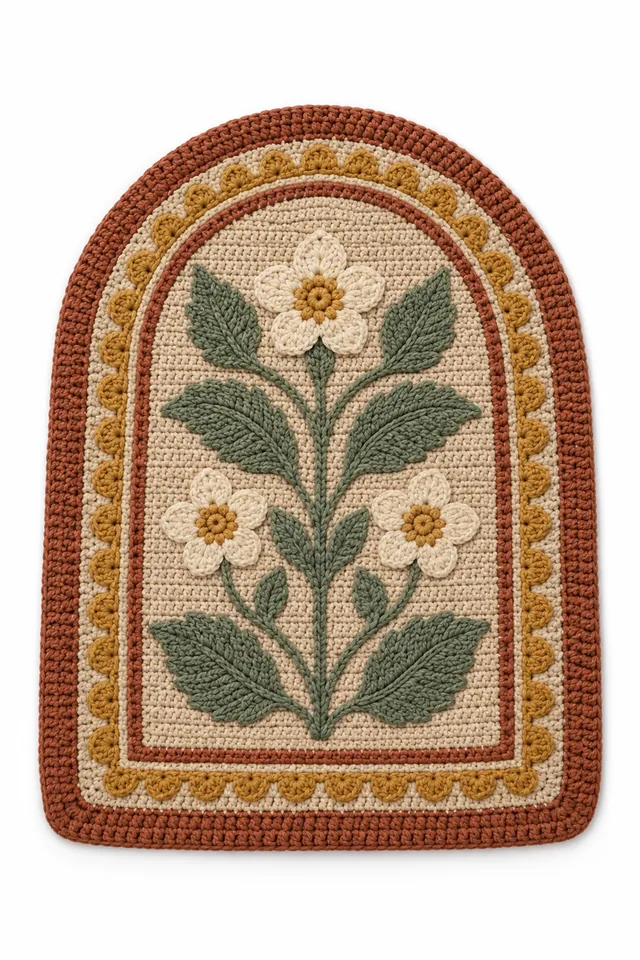
The lemon balm arch rug is the welcome of the collection — a doorway-shaped rug in fresh citrus green, scattered with the herb's heart-shaped leaves. An arch rug in front of a door or a stove reads as a threshold, a little entrance to stand on.
Lemon balm leaves are paired hearts along a stem — a naturally rhythmic motif. Repeated along an arch, they become a garland: the rug decorates the floor the way the herb decorates a doorway in old garden tradition.
For a mood board, this rug demonstrates the arch as hospitality. Curved-top rugs greet; they face you. Place arch rugs where people arrive — doors, the front of the sink, the bedside.
Compared with the basil capsule, the arch is directional where the capsule is neutral — it has a front and a back, an inside and an outside. Both are AI-generated concept images for inspiration, not patterns.
Thyme tile panel crochet rug
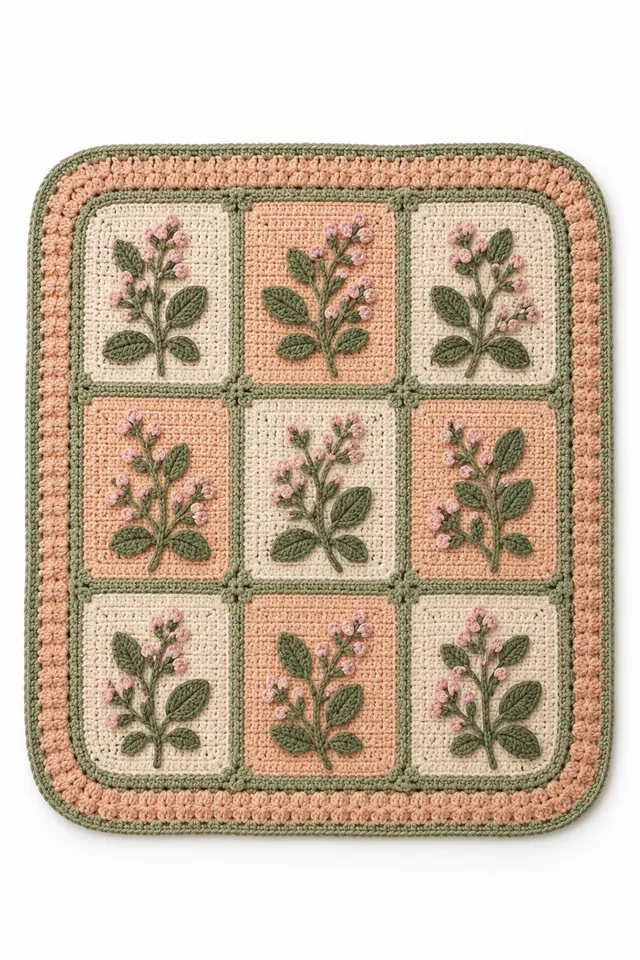
The thyme tile panel rug is the garden bed of the set — a rectangular field divided into small squares, each holding one tiny thyme sprig, like seed packets laid out in spring. Thyme grows as a creeping colony, and the tile layout honors that habit.
A tile grid is the most modular rug structure: each square is a small finished idea, and the rug is the sum. Modular layouts are forgiving in design — vary one tile and the whole piece gains rhythm.
For a mood board, this panel shows repetition with variation. Same sprig, different angle or tone per tile: that is the oldest trick in textile design and still the freshest. Grid plus variation equals calm interest.
Set against the basil capsule, thyme is the many where basil is the one — a herb bed versus a single leaf. All five images are AI-generated concepts for inspiration only, not patterns or product photos.
A herb garden you can stand on
These five rugs plant a kitchen garden underfoot — basil, rosemary, dill, lemon balm and thyme — each herb's growth habit becoming a rug shape: blade, oval, burst, arch and bed.
When planning botanical rugs, let the plant choose the geometry. A creeping herb wants a grid; a bursting herb wants a radial; a single bold leaf wants a capsule. The design is already growing in the garden.
All five images are AI-generated concept illustrations. They offer ideas for motif, texture and palette, but they are not photographs of finished crocheted pieces and include no patterns or instructions. Use them as a springboard for your own kitchen garden mood board.
Read how we present crochet inspiration or send a suggestion or correction.